BSTVC-R
BSTVC 



A powerful tool for ante-hoc spatiotemporal interpretable analysis.
Spatiotemporal heterogeneous perspective for analyzing local influencing factors (local spatiotemporal interpretability), identifying key global factors (global spatiotemporal interpretability), and making dynamic predictions, all within a unified ‘full-map’ framework.
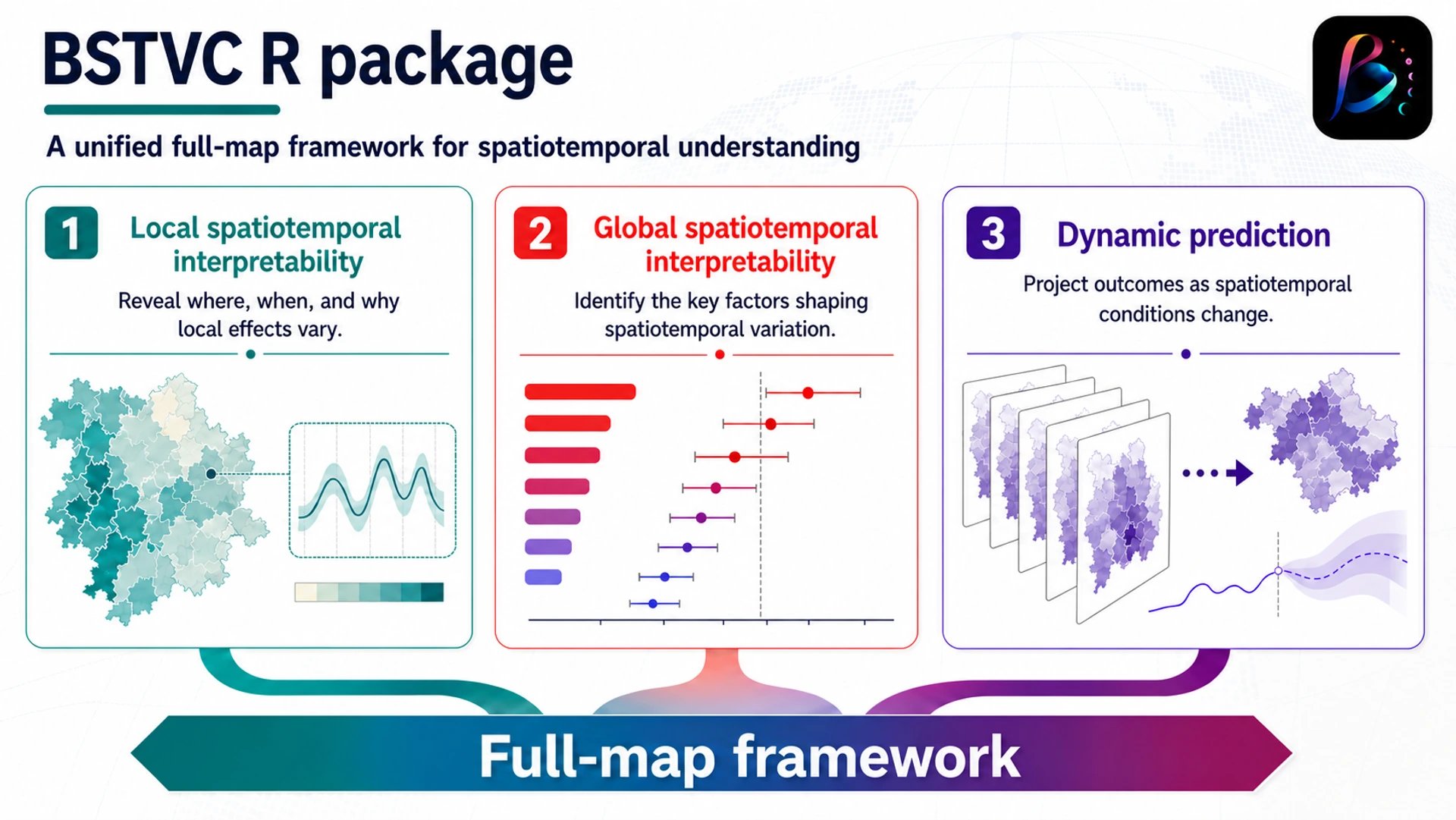
BSTVC unifies local spatiotemporal interpretability, global spatiotemporal interpretability, and dynamic prediction within a Bayesian full-map framework.
Scientific overview
BSTVC is a Bayesian modeling framework for investigating spatiotemporal heterogeneity in relationships between an outcome and its potential determinants. It is designed for research questions that require more than overall association estimates: the framework characterizes where and when local effects vary, evaluates the relative contribution of candidate factors at the global level, and supports prediction under changing spatiotemporal conditions. By integrating these analytical targets within one coherent workflow, BSTVC helps researchers connect local variation, global attribution, and predictive inference while retaining parameter uncertainty. The framework is applicable to spatiotemporal panel and areal data in public health, medical geography, environmental research, and related fields.
Interpretability framework
- Ante-hoc spatiotemporal interpretability means that interpretability is built into the statistical model through explicitly estimated parameters, rather than approximated after fitting an opaque predictive model.
- Local spatiotemporal interpretability describes how the direction and magnitude of a variable’s association with the outcome vary across space and time.
- Global spatiotemporal interpretability evaluates the overall importance of candidate factors in explaining spatiotemporal variation.
- Full-map framework refers to the unified analysis of local effects, global factor importance, and dynamic prediction across the complete study domain.
Installation
Install the BSTVC R package
Install BSTVC directly from GitHub:
# Install using the devtools package
# install.packages("devtools")
devtools::install_github("bayesianstvc/BSTVC")

# Install using the remotes package
# install.packages("remotes")
remotes::install_github("bayesianstvc/BSTVC")
Install the INLA dependency
BSTVC uses the INLA package for Bayesian latent Gaussian modeling. If
INLA is not already available in your R environment, install it from
the official INLA repository before installing BSTVC.
# Installation details: <https://www.r-inla.org/download/>
# Extend the download timeout to 5 minutes
options(timeout = 300)
install.packages(
  "INLA",
  repos = c(
    getOption("repos"),
    INLA = "https://inla.r-inla-download.org/R/stable"
  ),
  dependencies = TRUE
)
BSTVC Desktop

Chinese desktop version — BSTVC Desktop (时空可解释工具)
The Chinese desktop version, BSTVC桌面版(时空可解释工具), provides a more accessible graphical workflow for spatiotemporal analysis and interpretation. Visit the official website for the latest introduction and access information.
The English desktop version is coming soon — stay tuned.
Scientific capabilities
The BSTVC R package is designed to provide a comprehensive suite of
functionalities for advanced spatiotemporal heterogeneous analysis.
Its principal scientific capabilities include:
Model families and scientific outputs
| Analytical target | Supported model or output |
|---|---|
| Continuous response | Log-Gaussian regression |
| Binary response | Logistic regression |
| Count response | Poisson regression |
| Local interpretation | Spatiotemporally varying coefficient estimates |
| Global interpretation | Explainable-percentage and key-factor assessment |
| Prediction | Spatiotemporal smoothing, missing-value imputation, and forecasting |
| Model assessment | DIC, WAIC, effective number of parameters (pD), and logarithmic score (LS) |
-
Targeting multiple types of response variables: It supports three mainstream types of response variables: continuous (log-Gaussian regression), binary (logistic regression), and count (Poisson regression), accommodating various analytical scenarios.
-
Detecting spatiotemporal heterogeneous impact mechanisms: By fitting spatiotemporal regression coefficients, it reveals local spatiotemporal differences between explanatory variables (X) and response variables (Y), facilitating an in-depth analysis of context-specific patterns and exploring the impact mechanisms brought by spatiotemporal heterogeneity.
-
Identifying spatiotemporal driving factors: On the basis of identifying spatiotemporal heterogeneous impact mechanisms, it clarifies key driving factors by calculating the spatiotemporal explainable percentage, supporting geographical spatiotemporal attribution.
-
Supporting spatiotemporal prediction: By accounting for spatiotemporal heterogeneity in local variable relationships, the framework can improve model fit and predictive performance when such nonstationarity is present. It supports spatiotemporal missing-value imputation, smoothing, and forecasting.
-
Bayesian model assessment: It provides a comprehensive evaluation of Bayesian regression models, including model fitting (DIC, WAIC), complexity (pd), and prediction accuracy (LS) indicators, helping users fully understand model performance.
-
Rich visualization outputs: It provides a variety of spatiotemporal visualization tools and codes to help users intuitively examine model results and communicate spatiotemporal patterns and uncertainty in applied research.
The BSTVC framework integrates a full-map modeling strategy, Bayesian parameter uncertainty, support for missing values, and flexible spatial weight matrices within a unified analytical workflow.
Usage Guide
To help you quickly and fully get started with our R package for complex data analysis, we have prepared several detailed and comprehensive usage guides, as follows:
| Guide | Details |
|---|---|
| User’s Guide for the BSTVC R Package | This usage guide covers detailed example operations and important considerations for each key step, including data import, inspection, preprocessing, model fitting, result output and result visualization. You can view it in the GetStart.Rmd document under the vignettes folder, but it’s in R markdown format. If you want to download the help document in PDF format, please click here, the filename is GetStart-English.pdf. At the same time, to meet the needs of Chinese users, we have also provided a Chinese version of the usage guide, which can be downloaded and saved locally by visiting 用户手册-中文版.pdf. |
| Modeling Data Processing Guide | This usage guide demonstrates how to import the types of data required for the model and how to transform the raw data into the spatiotemporal panel data format that can be processed by the BSTVC model. The R code for achieving data processing for modeling is located in the Data_Preproc.R file under the data-raw folder. |
In the near future, we will continue to refine our documentation and provide new help documents.
Changelog
View detailed changelog: CHANGELOG.md
License
BSTVC-R is free for academic and other noncommercial use under the PolyForm Noncommercial License 1.0.0.
Commercial use requires a separate commercial license from the copyright holder. Previous versions released under GPL-3.0 remain under their original license; this change applies to versions from this commit onward.
Free for academic and noncommercial use.
Commercial use requires a separate license.
Project status and governance
- Maintenance status: Actively maintained. Bug reports and feature requests are reviewed through GitHub Issues.
- Contributing: Please read the Contribution Guide before proposing code, documentation, examples, or scientific validation.
- Community standards: Participation in the project is governed by the Code of Conduct.
Additional companion tool
INLA Process Monitor
INLA Process Monitor is a Windows companion tool for monitoring live inla.exe resource usage and comparing CPU, memory, and thread behavior. It helps users identify an appropriate thread setting and diagnose performance during Bayesian latent Gaussian model fitting. The tool runs locally and does not require a cloud service.
Contact
We welcome and encourage user contributions, including reporting issues, requesting new features, or submitting code changes. If you encounter any problems when using the BSTVC package or need further assistance, you can get support through the following means:
- GitHub Issues: Report reproducible software problems or request new features through the BSTVC issue tracker.
- Email: Contact Xianteng Tang for package usage questions, or Chao Song for questions concerning statistical methodology.
- Bayesian STVC model: https://chaosong.blog/bayesian-stvc/
Copyright ©HEOA-West China Health and Medical Geography Research Group
If you are a WeChat user, you are welcome to scan the QR code to follow our research group’s official account: HealthGeography

References
-
Bayesian STVC series models: Song, C., Yin, H., Shi, X., Xie, M., Yang, S., Zhou, J., Wang, X., Tang, Z., Yang, Y., & Pan, J. (2022). Spatiotemporal disparities in regional public risk perception of COVID-19 using Bayesian spatiotemporally varying coefficients (STVC) series models across Chinese cities. International Journal of Disaster Risk Reduction, 77, 103078.
-
STVPI: Wan, Q., Tang, Z., Pan, J., Xie, M., Wang, S., Yin, H., Li, J., Liu, X., Yang, Y., & Song, C. (2022). Spatiotemporal heterogeneity in associations of national population ageing with socioeconomic and environmental factors at the global scale. Journal of Cleaner Production, 373, 133781.
-
Song, C., Shi, X., & Wang, J. (2020). Spatiotemporally varying coefficients (STVC) model: A Bayesian local regression to detect spatial and temporal nonstationarity in variable relationships. Annals of GIS, 26(3), 277–291.
-
Song, C., Shi, X., Bo, Y., Wang, J., Wang, Y., & Huang, D. (2019). Exploring spatiotemporal nonstationary effects of climate factors on hand, foot, and mouth disease using a Bayesian spatiotemporally varying coefficients (STVC) model in Sichuan, China. Science of the Total Environment, 648, 550–560.